What Qualcomm’s Snapdragon X2 Linux Preview Supports Today—and What It Doesn’t
Qualcomm’s Snapdragon X2 Linux release gives developers a Debian 13 reference environment and a hardware-specific build path. It is not yet a general, install-and-go Linux release for every X2 laptop.

Linux on a Snapdragon X2 laptop is a real development target, but Qualcomm’s September 23 preview is still an early developer release. Its X2-specific software overview identifies SC8480XP as the reference platform and describes a Debian 13 “Trixie” image built from Qualcomm sources and prebuilt binaries. This is a developer path, not a standard Debian or Ubuntu installer promised to work on every X2 laptop.
The preview is a build path
Qualcomm scopes the preview to laptops with Snapdragon X2 Series processors. It says the work does not cover desktops, earlier Snapdragon X platforms, or other development boards. Readiness also varies by OEM design and processor variant. The announcement does not publish a model-by-model consumer compatibility list, so the X2 label alone does not tell an owner whether a specific machine will boot or which parts will work.
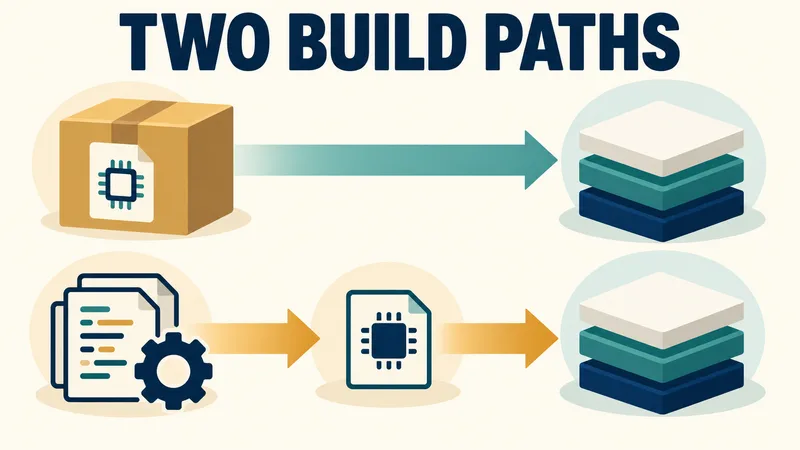
The X2 overview separates build paths by account access. Unregistered users can use prebuilt firmware binaries while building the Debian layer; a registered Qualcomm developer account is required to build firmware from source. The page also says registered users can find prebuilt firmware and Debian images in release notes and flash them directly. These access levels control software options, while hardware readiness still varies by OEM and variant. The workflow still requires validating the image on target hardware.
One linked resource has a different scope: the Qualcomm Linux Debian Images repository describes an IoT-focused project and initially lists RB1 and RB3 Gen 2 boards. It is not the X2-specific laptop guide; use the separate X2 overview and its flashing instructions for this preview.
A successful boot is one milestone
The initial roadmap covers UEFI startup through systemd-boot; USB and PCIe; UART, I2C, and SPI through Qualcomm’s universal peripheral serial engine; and ongoing Freedreno, Turnip, and Rusticl work for graphics and compute. Qualcomm also names FastRPC access to the Hexagon NPU for local inference, plus power management, thermal control, and system reliability.
These are enablement areas, not a blanket claim that every feature is finished on every laptop. Qualcomm describes the preview as a staged rollout, with driver support and hardware validation still progressing. A machine that reaches a shell or desktop has passed a boot test; that alone cannot establish that graphics acceleration, NPU workloads, peripherals, power behavior, or long-term stability are ready for a particular use.
A developer testing early boot has a different success condition from someone evaluating GPU compute or local inference. Qualcomm names the GPU and NPU as work areas but publishes no cross-model feature grid or performance benchmark in the announcement. Readers should check the exact function they need on the specific laptop rather than infer it from a successful boot on another design.
For Linux distributions, Qualcomm says out-of-tree patches can help with early bring-up, while upstream kernel support gives distribution maintainers a base they can use across kernel releases. Device-specific descriptions and drivers need review and maintenance in the shared kernel before support can be broadly reused.
Three timelines, three different promises
Qualcomm’s September developer post targets the end of November 2026 for completing current production-readiness work. It also says upstreaming will continue beyond November for mainline kernel updates, certification, and OEM commercialization. The date is a target for that work, not a guaranteed retail release date.
A separate Qualcomm OnQ post says Debian is expected by the end of 2026. It gives a different target for Ubuntu: Snapdragon X2 certification in the first half of 2027. The November target concerns preview-readiness work; the Debian statement concerns a distribution timeline; Ubuntu’s H1 2027 date concerns certification. None promises that every X2 laptop will have the same working Linux configuration on those dates.
The Debian dates describe different things too: Trixie is already the user-space base in the preview, while the end-of-year statement is Qualcomm’s separate timeline for Debian support. The latter does not establish that a general-purpose Debian installer is ready for every X2 design.
What developers should verify
Before testing a specific notebook, start with its exact model and X2 variant, then check that the available software and device-tree instructions name that target. Identify the functions your workload depends on and confirm their status on that machine: graphics acceleration, NPU access, I/O, display, power, and thermal behavior may mature on different schedules. Keep tests tied to the hardware in hand rather than generalizing from a different X2 design.
The Hacker News discussion showed 625 points and 273 comments in an October 12 snapshot; the linked r/hardware thread showed 127 votes in the same research snapshot. Comments raise questions about how device-tree files and ACPI or firmware information will be supplied and maintained across laptop models. Those are community questions, not verified compatibility findings or a representative survey. They point to the practical question the announcement leaves open: which exact laptop, with which drivers, can a distribution support across updates?
Developers willing to build, flash, and test now have an early path into X2 Linux. Laptop buyers should look for a named device-and-distribution support list or certification tied to a specific model.
Sources & further reading
- Announcing Linux on Snapdragon X2 Series Early Developer PreviewQualcomm Developer Blog · accessed Oct 12, 2026
- Inside Snapdragon Summit 2026: Agentic AI PCs, Googlebooks and Linux are hereQualcomm OnQ · accessed Oct 12, 2026
- Linux support is coming to Snapdragon X2 seriesHacker News · accessed Oct 12, 2026
- Announcing Linux on Snapdragon X2 Series Early Developer Previewr/hardware (Reddit) · accessed Oct 12, 2026
- Snapdragon X2 Series Linux software overviewQualcomm Documentation · accessed Oct 12, 2026
- Qualcomm Linux Debian ImagesQualcomm Linux on GitHub · accessed Oct 12, 2026