The ONS Sets Out Six Stages to Measure AI in the UK Economy by 2028
The Office for National Statistics published a methodology article on 21 September 2026 setting out how it will build an artificial intelligence thematic account for the UK national accounts, using the System of National Accounts 2025 definition and 23 product categories, with a prototype window in 2027 and an experimental account targeted for March 2028. Its own surveys show AI use by businesses with 10 or more employees rising from about 12% in 2023 to around 35% in the June 2026 wave, which the ONS says is still a large step from a value-based estimate.
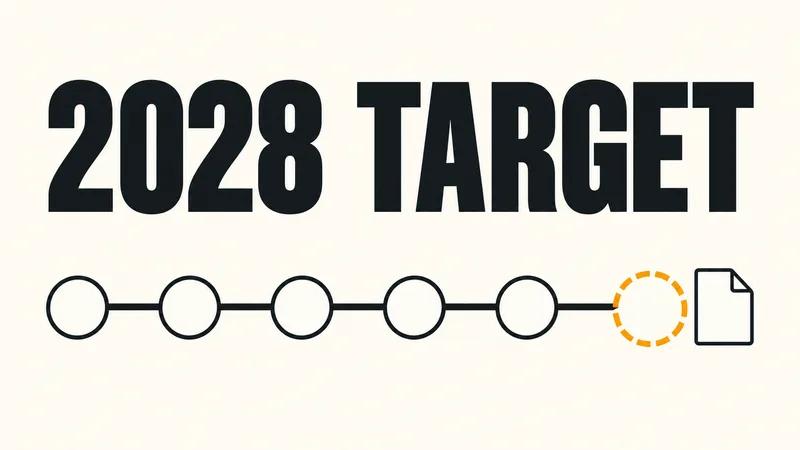
The Office for National Statistics has set out how it intends to measure artificial intelligence in the UK economy, and its own timeline puts the first experimental account at the start of 2028. The document published on 21 September 2026 is a methodology rather than a set of results, and it is explicit about what official statistics cannot separate today.
The ONS methodology article describes a thematic account that will sit alongside the national accounts without changing them. The approach was formally agreed by the Advisory Panel on National Accounts in September 2026, and the ONS says it will publish update articles as the work proceeds.
Why AI is hard to find in the national accounts
The framework used to calculate gross domestic product, the System of National Accounts 2008, does not explicitly refer to artificial intelligence, although research and development and computer software sit inside its asset boundary. Its successor, the System of National Accounts 2025, brings AI, data, cloud computing and other parts of the digital economy explicitly into the guidance.
The ONS lists the measurement problems that follow. AI has no universally accepted definition, and one that is too broad or too narrow will overstate or understate the sector. AI is embedded in robotics and other software, so the investment is hard to isolate, and workers answering a survey may not realise they are using it. Use ranges from a formal place in production to ad hoc individual habits, and those intensities do not affect productivity in the same way.
Two narrower problems matter for the numbers. Detailed AI investment data is strategically sensitive in defence and security, and individuals using personal AI accounts for work blur the line between household and business use.
What counts as AI in the proposed account
The account will use the definition in the System of National Accounts 2025, where AI is an "of which" category of computer software: "capabilities of a computer program, or system controlled by a computer program, of recognition, reasoning, communication, and prediction emulating human recognition, reasoning, and communication". Because an AI program needs hardware and software to deliver compute, the scope stretches across what the ONS calls the AI production stack.
In practice that covers AI infrastructure such as AI hyperscale data centres, AI factories, cloud services and model hubs, goods including AI chips, AI hardware, embedded electrical goods, autonomous robotics, vehicles and drones, and services such as AI development, training, strategy, deployment and security. It reaches downstream users as well, on the argument that medical diagnosis, education and recruitment are important users of AI and therefore contribute to the sector's gross value added.
That scope produced 23 product categories in the Classification of Products by Activity, which the ONS matched against the published supply and use tables for reference year 2023. Two candidates were left out of that year because the services did not exist in it: robotaxis and drone deliveries. The classification itself is still moving. The new UK Standard Industrial Classification for 2026 creates one AI subclass, 62.131 for general purpose AI tool development, and the ONS has not adopted it yet, while a revised product classification that may carry AI subclasses has a provisional publication date of December 2026.
What the surveys already show
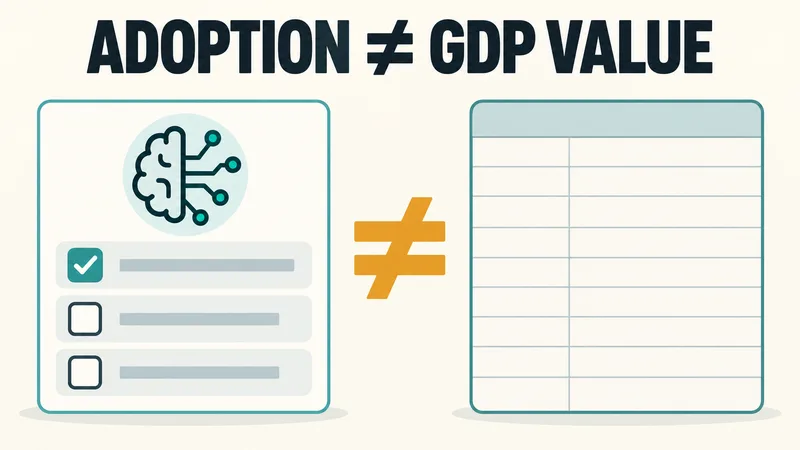
Existing ONS surveys describe adoption and stop short of a value. In the Business Insights and Conditions Survey, the share of businesses with 10 or more employees using at least one AI technology rose from about 12% in 2023 to around 35% in the June 2026 wave. Among businesses with more than 250 employees it reaches 49%. Text generation with large language models was the most common use at 17%, ahead of visual content creation at 14%, and both are up 12 and 11 percentage points since the question was introduced in September 2023. By industry, 58% of information and communication businesses reported AI use, against 51% in education, 46% in professional, scientific and technical activities, and 13% in construction.
How businesses get the technology decides how it lands in the accounts. Of those using AI, 45% used free-to-use software, 43% bought external or ready-to-use software, and 12% developed it in house. Purchased software and software built for own use can count as investment, while access bought through a cloud agreement is intermediate consumption unless a UK resident owns the platform.
The Opinions and Lifestyle Survey covers individuals: 41% of adults had used AI for work or education in the previous 12 months, 27% at home and 23% for hobbies, while 33% reported no known use. Only 36% agreed AI would benefit them, and trust ran higher for customer support at 27%, scientific research at 25% and creative tasks at 24% than for government decision-making at 4% or caregiving at 5%.
What UK AI companies say they sell
For the supply side, the ONS worked from a list of about 5,860 UK registered AI companies supplied by the Department for Science, Innovation and Technology, together with the activity description attached to each. A keyword analysis of those descriptions found data analytics, forecasting and decision support in 38.4% of them, AI consulting and digital transformation in 30.7%, and business process, workflow and document automation in 27.3%. Finance and compliance appeared in 18.9%, customer engagement and content in 17.0%, and computer vision and language in 16.7%. Seven further categories, from energy and infrastructure to AI platforms and data infrastructure, ranged from 15.8% down to 5.9%.
The categories overlap, because one company can appear in several, and the ONS calls the exercise indicative rather than exclusive. The analysis was generated by an AI prompt over the company descriptions and then cross-checked by the ONS, and the company list is experimental and the best currently available. By industry classification, 64.6% of the companies sit in information and communication, 19.9% in professional, scientific and technical activities, 4.3% in administrative and support services and 2.6% in manufacturing, with some sections suppressed under statistical disclosure controls.
Six stages, and the first account in 2028
Scope and foundations were set in the second quarter of 2026, and governance, stakeholder requirements and classification links in the third. The evidence and data landscape, covering survey, administrative and private sector options, runs to the end of 2026. Methodology options and feasibility tests are due in the first quarter of 2027, followed by a prototype window from the second to the fourth quarter of 2027 in which the ONS plans to test how to split AI from non-AI products across domestic output, imports, gross value added and gross fixed capital formation. The target by March 2028 is an experimental account ready to be productionised, with estimates of AI's effect on GDP, gross value added by industry, and the split between domestic and imported supply.
The ONS also expects to compile experimental estimates of the supply of AI compute services, and their contribution to GDP, for a reference year in current prices after the first quarter of 2027. Productionised annual and quarterly estimates are the objective after the first quarter of 2028.
The questions the roadmap has to settle
The article lists what the work still has to solve: splitting broad product categories into AI and non-AI activity for producers and for adopters, choosing methods for boundaries that blur between AI and other technologies, maintaining a population of AI businesses when industry classification is not a reliable indicator, separating AI from non-AI revenue inside the turnover of diversified companies, finding alternative data sources for the gaps, and producing estimates quickly enough to be useful.
The ONS states that moving from adoption figures to a value-based estimate of what adoption costs and what it delivers is a large step, and it is inviting feedback on the approach while the work continues.
Sources & further reading
- Measuring artificial intelligence in the UK economy using a thematic accountOffice for National Statistics · accessed Oct 12, 2026
- Measuring Artificial Intelligence in the UK Economy using a thematic account (release page)Office for National Statistics · accessed Oct 12, 2026
- Release calendar (published releases, newest first)Office for National Statistics · accessed Oct 12, 2026