Giants and Commanders Tie 27-27 After Both Teams Missed Chances to Win in Overtime
New York and Washington each reached a potential winning field goal in overtime, but a fumble and a final clock-management breakdown left the game tied.
The New York Giants and Washington Commanders finished 27-27 in overtime on October 11, but the final score hides how close each team came to winning. New York had a field-goal chance and chose to move closer; a fumble handed Washington the ball. The Commanders then reached the Giants’ 26 with 55 seconds left and no timeouts, but the final possession ended without a kick. The NFL game center records the tie and the overtime result.
New York’s chance ended with a fumble
The Giants had first-and-10 at Washington’s 24 on the third overtime possession. A field goal would have ended the game. The distance was makeable, but kicker Dominic Zvada had already missed from 50, 57 and 46 yards, so head coach John Harbaugh chose to use the clock and try to gain a few more yards first. Washington had no timeouts. If New York drained enough time before a kick, a miss would leave the Commanders little or no chance to answer.
The NFL/AP recap describes this as the third possession of overtime and a sudden-death situation. By then both offenses had touched the ball without breaking the 27-27 tie, so New York’s next points would end the game. Harbaugh’s choice was therefore about two risks at once: whether to trust a kick after earlier misses, and whether a failed attempt would leave Washington enough time to respond.
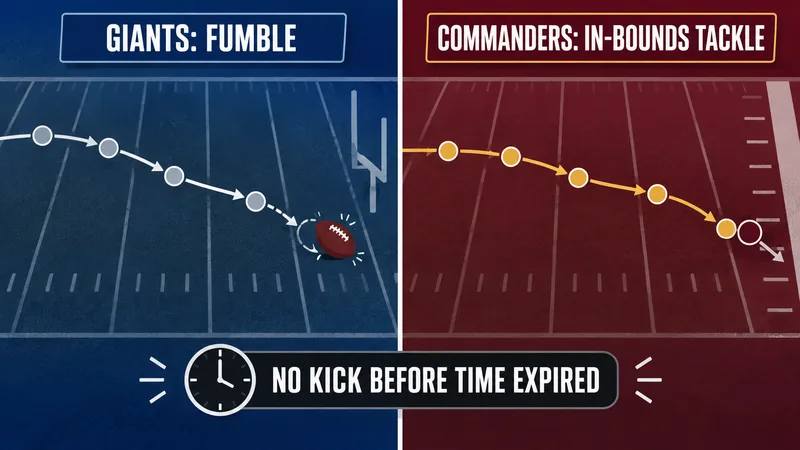
That plan lasted one play. Cam Skattebo carried the ball and was hit behind the line; Daron Payne forced a fumble and Shy Tuttle recovered for Washington. The turnover turned a cautious attempt to improve field position into the Giants’ lost winning chance. It is not possible to know whether Zvada would have made the earlier kick.
Washington had the ball and the clock
The Commanders moved across midfield, then Jayden Daniels completed a pass to Treylon Burks, who went out of bounds at the New York 26 with 55 seconds remaining. Washington was in position to run time down and try its own winning field goal. It had no timeouts, which made the next sequence unusually sensitive to whether a play ended in bounds.
After a short run by Rachaad White, the clock was moving. Washington could have let it run and saved a spike for the last few seconds, but the offense huddled with 27 seconds left. The plan was to find a sideline throw, with an incompletion as a backup clock stop. Daniels rolled left on the snap and was tackled in bounds instead. The clock kept running; the offense did not line up in time to spike the ball before it expired.
The NFL’s account of the final possession says Daniels and Quinn both accepted responsibility for the communication and clock decisions.
Why the tie has two separate endings
The game did not turn on one missed kick. New York tried to protect against a miss by moving closer, then lost the ball. Washington gained the same kind of winning opportunity, but did not preserve enough time to complete a kick sequence. Those were different mistakes, made by different teams, with the same outcome.
Sources & further reading
- New York Giants at Washington Commanders 2026 REG 5 — Game CenterNFL · accessed Oct 12, 2026
- Commanders QB Jayden Daniels says team’s botched final play vs. Giants was on himNFL / Associated Press · accessed Oct 12, 2026