FDA Recall Classes Explained, and Why Some Notices Carry No Grade
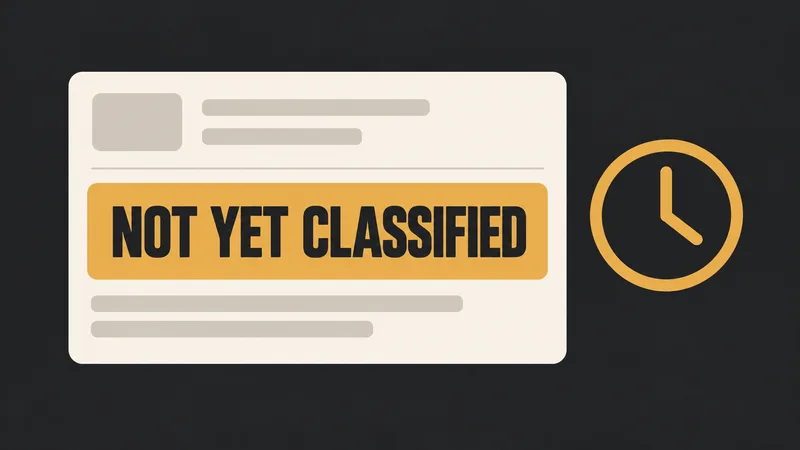
FDA recalls are graded Class I, Class II, Class III or left as Not Yet Classified, and the grade often appears after the public warning because classification follows the firm's submission of the information needed to judge risk. The Enforcement Report is where a reader can check the grade, the status and the lot information.
Why a recall notice often carries no grade
When the FDA posts a recall notice, the page frequently carries no classification, which confuses readers who expect a severity label. The explanation sits in the agency's own Enforcement Report documentation.
The FDA classifies recalls as Class I, Class II or Class III, or leaves them as "Not Yet Classified". A classification is assigned after the recalling firm provides the information the agency needs to determine the risk a product poses to public health, so it can arrive long after the first public warning.
The documentation is explicit on a point that matters for reading notices: classification and posting in the Enforcement Report should not be seen as an expansion of, or a change to, a firm's voluntary public warning.
What the three classes mean
The definitions are short, and the difference between them is the whole point of the system.
Class I is a situation in which there is a reasonable probability that the use of, or exposure to, a violative product will cause serious adverse health consequences or death.
Class II is a situation in which use of, or exposure to, a violative product may cause temporary or medically reversible adverse health consequences, or where the probability of serious adverse health consequences is remote.
Class III is a situation in which use of, or exposure to, a violative product is not likely to cause adverse health consequences.
A recall pending classification displays as "Not Yet Classified" rather than being left blank, which is informative in itself: the agency has determined the firm's action meets the definition of a recall but has not finished the hazard assessment.
Why the delay exists
The agency's explanation is procedural. Most of the time, classification follows the point at which the recalling firm has supplied all the information needed to judge the risk.
That sequence produces the pattern many readers have noticed: a company announces a recall, news outlets cover it, and the graded entry appears later. Firms often initiate voluntary recalls and publish their own statements as part of protecting consumers, and those can come well before the agency completes classification.
Since June 15, 2017, the Enforcement Report has listed pending-classification recalls alongside classified ones, so the public sees them sooner rather than waiting for the grade.
How to look up a specific recall
The Enforcement Report is the system of record, and it can be approached in four ways.
The weekly report publication lists recalls by year and month. The advanced search filters by product description, code information, product type, recall class, recalling firm, status, recall number, reason for recall, classification date or event ID. An application programming interface, documented separately, pulls the same data without the interface.
Inside a report there are four views: Product View, the default, which displays information by product; Event View, which groups products in a single recall event; Print View, which puts everything for each product type on one page; and an export to comma-separated values for spreadsheet work.
To find recalls awaiting classification, select "Not Yet Classified" in the Recall Class filter. The documentation notes that this disables the classification date fields, because those records do not have one.
The fields that answer practical questions
Each entry carries fields that answer questions a recall notice may leave open.
Status shows where the recall stands: On-Going, Completed or Terminated. Completed means the firm has retrieved and impounded all outstanding product that could reasonably be expected to be recovered, or has completed all corrections. Terminated is stronger: the agency has determined that all reasonable efforts were made to remove or correct the product and that proper disposition was made in line with the hazard.
Other fields include the recalling firm, the distribution pattern, which is the general area of initial distribution and may not include later distribution by consignees, code information covering lot or serial numbers and dates, the reason for recall, product quantity, whether the recall was voluntary or mandated, the recall initiation date, the initial notification method, the recall number, the event ID, the center classification date and any press release links.
Two of those matter most when a notice gives no lot details: code information and the distribution pattern. If neither appears, the notice itself is the limit of what has been published.
What this means for reading a notice
The practical rule is to treat the announcement and the grade as two documents on two different clocks.
A notice tells you what was recalled, where it went and what to do. The Enforcement Report entry tells you how the agency ultimately graded the hazard, whether the recall is complete or terminated, and which lot information was recorded.
If a notice you are reading has no class, that is not an omission by the company and not a signal of severity in either direction. It means the classification step had not finished when the alert was posted, and the Enforcement Report is where to check later.
The agency also runs a separate pilot for expedited notification of certain non-blood product recalls, and lists import alerts as a distinct enforcement tool for detention without physical examination, which is a different mechanism from a recall.
Sources & further reading
- Enforcement ReportsU.S. Food and Drug Administration · accessed Oct 12, 2026
- Enforcement Report Information and DefinitionsU.S. Food and Drug Administration · accessed Oct 12, 2026
- Recalls, Market Withdrawals, & Safety AlertsU.S. Food and Drug Administration · accessed Oct 12, 2026